

Beberlis

Support Children’s Foot Growth

How to Choose the Right Size and Support Your Child’s Foot Growth

As August comes to an end, the countdown to the back to school season begins. Books, backpacks, uniforms… and of course, school shoes. For many parents, this last item raises the most questions: which size should I buy? How often do children need new shoes? Can shoes be handed down from one sibling to another?

In this article, we’ll answer all these questions with the support of trusted medical sources and practical tips so your child can start the school year in comfort – and with healthy feet.

Why check your child’s shoes before the school year starts?

Children’s feet grow quickly, especially during the early school years. Medical research from National Library Medicine confirms that:

  • Between 12 and 30 months, children need new shoes every 2–3 months.

  • Between 2 and 4 years old, roughly every 4 months.

  • Between 4 and 6 years old, every 6 months.


Other podiatry experts like My Chicago Foot Expert  or AFC Dallas highlight that from ages 3 to 6, children’s feet can grow half a shoe size every 4–6 months, while between 6 and 10 years old, they may grow one to two sizes per year.

That’s why late August is the ideal time to check whether school shoes still fit – or if it’s time to size up.

Support Children’s Foot Growth

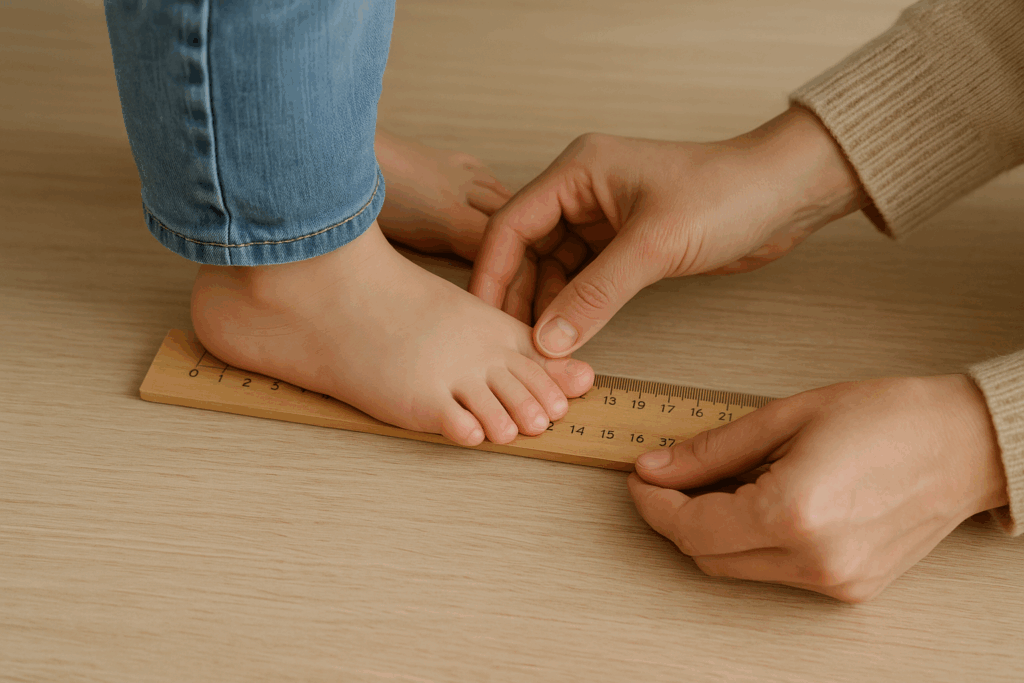
How to measure your child’s feet correctly

Getting the right size helps you avoid common mistakes like buying “a size bigger so they last longer”, which can be just as harmful as shoes that are too small.

👉 For a step-by-step guide, visit our dedicated article:
Kids Shoe Size Chart – How to Measure Children’s Feet Correctly

In short, keep these tips in mind:

    • Measure both feet and go with the larger one.

    • Do it at the end of the day, when feet are slightly bigger.

    • Leave 0.5–1 cm of extra space at the toes.

    • Repeat the process every few months, especially before school starts.

Can school shoes be handed down between siblings?

Although it’s common practice, experts like Texas Foot Doctor recommend avoiding second-hand shoes:

  • Every foot has a unique walking pattern, and worn shoes are already moulded to the previous child.

  • This can affect the natural gait of the next wearer.

  • Used shoes may also carry fungi or bacteria, particularly in warm or damp months.

Practical tips for choosing the best school shoes

  • Breathable, flexible materials: natural leather or technical fabrics that allow ventilation.

  • Non-slip soles: essential for playgrounds and school corridors.

  • Adjustable fastenings (Velcro or laces): better fit and support around the instep.

  • Lightweight design: less fatigue after a full school day.

  • Regular checks: measure at the start of term and every 3–4 months afterwards.

  • Rotate pairs: alternating shoes helps them air out and hold their shape.

Children’s foot growth timeline (school age guide)

Estimated Growth: 2-3 sizes per year

Shoe check frequency: every months

Estimated Growth: around 2 sizes per year

Shoe check frequency: every 4 months

Estimated Growth: 1-2 sizes per year

Shoe check frequency: every 6 months

Estimated Growth: 1-2 sizes per year

Shoe check frequency: 1-2 times per year

The back to school season is more than just getting uniforms and school supplies ready – it’s also the perfect moment to ensure your child wears shoes that support healthy foot development.

Choosing the right size, checking regularly, and avoiding second-hand shoes are small but essential steps that make a big difference in children’s comfort and posture.

At Beberlis, we design children’s shoes that adapt to every stage of growth, so your little ones can learn, play and grow with the best support for their feet.